The 10 Commandments: Full List, Meaning, and a Prayer to Live Them Out
Most people can name maybe three or four of the 10 Commandments before they get stuck. That’s not a failure of memory so much as a sign of how these ten lines get taught — as a list to recite rather than a story to enter. They come from Exodus 20, given to Moses on Mount Sinai, and they were never meant to be a cold set of prohibitions. They’re closer to directions home, written for a people who had just walked out of slavery and needed to learn how to live free.
This guide walks through the full list, the story behind it, what Jesus said about it centuries later, and how these ancient words still shape how we love God and each other today.
What Are the 10 Commandments? (Quick List)
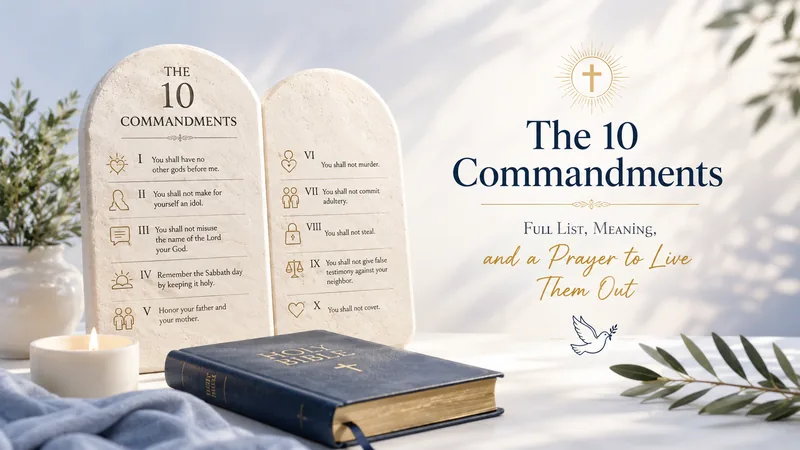
Here’s the full list of the 10 Commandments, in the order most Protestant traditions follow:
1. You shall have no other gods before Me — Give God the first and highest place, above every other loyalty.
2. You shall not make any idols — Don’t shrink God down into an image or object.
3. You shall not take the Lord’s name in vain — Don’t misuse God’s name or carry it carelessly.
4. Remember the Sabbath and keep it holy — Set aside regular time to rest and honor God.
5. Honor your father and your mother — Respect and care for your parents.
6. You shall not murder — Protect and value human life.
7. You shall not commit adultery — Stay faithful within marriage.
8. You shall not steal — Respect what belongs to others.
9. You shall not bear false witness — Don’t lie, especially about other people.
10. You shall not covet — Guard your heart against destructive desire for what isn’t yours.
That’s the shorthand version. The story behind them — and what each one actually asks of us — is worth slowing down for.
The Story of the 10 Commandments — Moses and Mount Sinai
How God Gave the Commandments Through Moses
The scene in Exodus 19 is dramatic on purpose: thunder, lightning, a thick cloud sitting over the mountain, the blast of a trumpet growing louder. Moses climbs up to meet God, and what comes down the mountain with him isn’t a suggestion box — it’s a covenant. God speaks the Ten Commandments directly to the people first (Exodus 20:1), then has them written on stone tablets.
There’s an old debate about how the ten were split across those two tablets. Some think the first tablet held commandments 1 through 5, the ones dealing mostly with our relationship to God, and the second held 6 through 10, the ones about how we treat each other. Others divide it differently, based on the weight and length of the Hebrew text. Either way, the two-tablet structure mirrors something the Commandments do throughout: they hold our vertical relationship with God and our horizontal relationships with people side by side, as if you can’t really have one without the other.
From Slavery in Egypt to Covenant with Yahweh
It matters that these words come right after the Exodus, not before it. God doesn’t hand Israel a rulebook and then offer to rescue them if they follow it well enough. He rescues them first — out of Egypt, out of Pharaoh’s grip — and then gives them the Commandments as a way to live as a free people. The opening line makes this order explicit: “I am the LORD your God, who brought you out of the land of Egypt, out of the house of slavery” (Exodus 20:2). Everything that follows is framed as instruction for people who already belong to God, not a test they have to pass to earn that belonging.
The 10 Commandments Explained One by One
1. No Other Gods Before Yahweh
The first commandment sounds simple until you sit with the phrase “before Me.” In Hebrew it can mean in front of, beside, against, or instead of — which stretches the command further than just “don’t worship other deities.” It’s really about where anything else is allowed to sit in relation to God. Career, money, comfort, even family can quietly take first place in a life without anyone ever bowing to a statue. The command is a guardrail against letting anything less than God claim that seat.
2. No Idols — Honoring God’s Living Image
The second commandment forbids carving or shaping an image of God. Part of the reasoning shows up in how it’s phrased in Deuteronomy: the people saw no form at Sinai, only fire and cloud, so they had nothing to copy. Trying to contain God in wood or stone actually shrinks who God is. There’s a striking flip side to this one, though — Scripture already has a “living image” of God, and it’s not an object at all. It’s people. Every person carries that image, which means how we treat each other says something about how seriously we take this commandment.
3. Don’t Take God’s Name in Vain
This isn’t primarily about cursing, though that’s the common shorthand. The deeper idea is “carrying” God’s name for a hollow or false purpose — using it to back up a promise you don’t intend to keep, or attaching it to something it shouldn’t be near. Ancient Israelites who represented God publicly, like priests, “carried” His name into their work. Misusing that name wasn’t just bad manners; it undercut the trust between God and the people who were supposed to reflect His character.
4. Remember the Sabbath (Shabbat)

The Hebrew word behind Sabbath, shabbat, simply means “to stop.” Not slow down — stop. The fourth commandment sets aside a full day to cease work and rest, patterned after God resting on the seventh day of creation. What’s easy to miss is how generous the command is: it extends rest to servants, animals, and even foreigners living among the Israelites, not just the head of the household. This wasn’t a day off for the privileged few. It was a shared rhythm meant to remind everyone, regardless of status, that they weren’t machines built only to produce.
5. Honor Your Father and Mother
This commandment is the hinge of the whole list. The first four are about our relationship with God; the last five are about how we treat other people. Honoring parents sits right at that pivot point, tying love of God to love of neighbor through the most immediate relationship most of us have. It comes with a promise attached — “that your days may be long in the land” — linking respect for parents to the wellbeing of the whole community, not just individual households.
6. You Shall Not Murder
The Hebrew word used here, ratsach, is broader than the English “murder.” It covers both intentional killing and death caused through negligence, which is part of why later biblical law makes room for cases like accidental killing or self-defense. The core principle stays the same across all of it: human life carries weight because it’s made in God’s image, and no one gets to decide it’s expendable.
7. You Shall Not Commit Adultery
Marriage in the Bible isn’t just a legal arrangement — it’s described as two people becoming “one flesh,” a relationship meant to reflect something of God’s own faithfulness to His people. Adultery breaks that covenant at its root. This is one of the commandments Jesus later pushes even further, tracing the harm back to intention and desire rather than just the act itself.
8. You Shall Not Steal
Stealing assumes that what belongs to someone else should really belong to you. The eighth commandment pushes back on that assumption by framing possessions as gifts, not entitlements. Old Testament law goes further than just “don’t take things” — it actually expects people to return a neighbor’s lost animal or misplaced coat, turning the command into something closer to active care than passive restraint.
9. You Shall Not Bear False Witness
This one grew out of a very concrete setting: ancient Israelite justice happened in public, often at the city gate, where witnesses spoke and elders decided cases. A false statement there could get an innocent person punished or a guilty one set free. The command protects the integrity of that whole system, with particular concern for people who had the least power to defend themselves if a lie was told against them.
10. You Shall Not Covet
The last commandment is the odd one out, because it targets a feeling rather than an action. “Covet” is closer to “destructively desire” than simply “want.” Wanting things isn’t automatically wrong — even Eden was full of trees that were good to look at. The danger is desire left untrained, the kind that eventually pushes a person toward stealing, lying, or worse to get what they’ve decided they’re owed. It’s the one commandment aimed straight at the heart, not the hands.
What Did Jesus Say About the 10 Commandments?
Loving God and Loving Neighbor — The First Four vs. the Last Six
When someone asked Jesus which commandment mattered most, He didn’t pick one of the ten. He summarized all of them: love God with everything you have, and love your neighbor as yourself (Matthew 22:37-40). That’s basically a compressed version of the same two-tablet structure from Sinai — the first four commandments show what loving God looks like, and the last six show what loving other people looks like.
Jesus didn’t lower the bar on the original commandments; if anything, He raised it. He said that harboring anger toward someone puts a person in the same moral territory as murder (Matthew 5:21-22), and that looking at someone with lustful intent is already a form of adultery in the heart (Matthew 5:27-28). The outward act was never really the whole point. The commandments were always aimed at the kind of person you’re becoming, not just the behavior you manage to avoid.
Catholic vs. Protestant Numbering of the 10 Commandments

If you’ve ever compared a Catholic list of the Ten Commandments to a Protestant one and noticed the numbers don’t line up, you’re not imagining it. Most Protestant traditions treat “no other gods” and “no idols” as two separate commandments (numbers 1 and 2), then split the final command against coveting into one single command. Catholic and Lutheran traditions combine the first two into one commandment, then split the last one into two — coveting a neighbor’s spouse gets counted separately from coveting a neighbor’s property.
Both traditions land on ten total, and the content is identical either way. The difference is really just how the text gets divided up, not a disagreement about what the commandments actually say.
A Prayer for Living Out the 10 Commandments
Lord, You didn’t give these words to box us in — You gave them so we could walk free. Teach me to put nothing above You, not comfort, not fear, not the small idols I build without noticing. Help me guard my words, protect my rest, and honor the people who raised me. Keep my hands from harm and my heart from envy. Where I’ve broken faith — with You or with someone I love — meet me with the same mercy You’ve always offered Israel. Let these commandments be less like rules I follow and more like a road I walk with You. Amen.
Are the 10 Commandments Still Relevant Today?
Wisdom for Flourishing, Not Just Rules
It’s tempting to read the Ten Commandments as an ancient legal code with no bearing on modern life — after all, most of us aren’t tempted to carve idols out of wood. But look at what’s actually underneath each command: exclusive devotion, honest speech, protected life, faithful relationships, contentment over envy. None of that has expired. If anything, a world full of divided attention, broken trust, and constant comparison needs this list more than ever.
There’s an image worth sitting with here — a life shaped by this kind of wisdom is described elsewhere in Scripture as a tree planted by streams of water, bearing fruit in its season (Psalm 1:3). The Commandments were never meant to just restrain people. They were meant to root them somewhere solid enough to grow.
Frequently Asked Questions About the 10 Commandments
Where are the 10 Commandments found in the Bible?
They appear in Exodus 20:1-17 and again, with slight wording differences, in Deuteronomy 5:6-21.
Are the 10 Commandments only for Israel, or for everyone?
They were first given specifically to Israel as part of their covenant with God. Christians generally read them as revealing timeless moral principles — the value of honesty, faithfulness, and reverence for life — even while understanding they were given in a particular historical moment.
Which stone tablet had which commandments?
Scholars differ. One common view splits commandments 1-5 (about God) onto the first tablet and 6-10 (about people) onto the second. Others divide it by the length of the Hebrew text rather than by theme.
Did Jesus cancel or replace the 10 Commandments?
No — Jesus said He came to fulfill the Law, not abolish it (Matthew 5:17). He deepened its meaning, pushing past outward compliance toward the intent behind each command.
Why do Catholic and Protestant lists of the Ten Commandments look different?
The two traditions divide the same ten commands differently — Catholics combine the first two into one and split the last into two, while most Protestants keep the first two separate and combine the last one. The underlying content is the same.
The Ten Commandments were never handed down as a burden. They were handed to a people just out of slavery, still learning what freedom was supposed to feel like — and the answer they got was this: freedom looks like loving God first, and loving the people around you as if their lives matter as much as your own. That’s still the invitation, thousands of years later.